







Aviz ONES + vCluster
Overview
AI Cloud providers and AI factories are moving from long-term bare-metal contracts to on-demand, multi-tenant services, so GPU servers are now constantly reassigned between tenants. The compute side can hand a server to a new tenant in minutes, but the network is still changed by hand: an engineer moves the server's switch ports from one tenant's private network to the next. That step is slow, and if it is missed, a server can stay on the previous tenant's network and expose its traffic.
How vCluster and Aviz Networks solve it together
vCluster coordinates the tenant workflow and decides which server goes to which tenant. vMetal provisions the server, and vCluster gives each tenant cluster its own control plane on dedicated Private Nodes. Aviz ONES gives each tenant its own network segment (VXLAN or VLAN) across the switch fabric, and vCluster assigns each tenant's IP addresses from the subnet the provider configures. When vCluster assigns or releases a server, it calls Aviz ONES, which adds the server to or removes it from the tenant network automatically.
The result: AI Cloud providers run their AI cloud the way a hyperscaler runs a VPC, on their own hardware and switches. The integration is available in vCluster v5.0 through vMetal's Metal3 driver, with a vCluster license that includes the Aviz integration.
Compute Moves in Minutes. The Network Doesn't.
On-demand services only work when new tenants come online fast and returned servers go straight back into service. Compute and Kubernetes layers have become programmable. The tenant network has not.
The Joint Solution: Isolation from Server to Switch
vCluster and Aviz Networks split the work along a clean line. vMetal provisions the servers and vCluster provides tenant clusters; Aviz ONES automates tenant network isolation and server connectivity; vCluster coordinates both in one workflow.
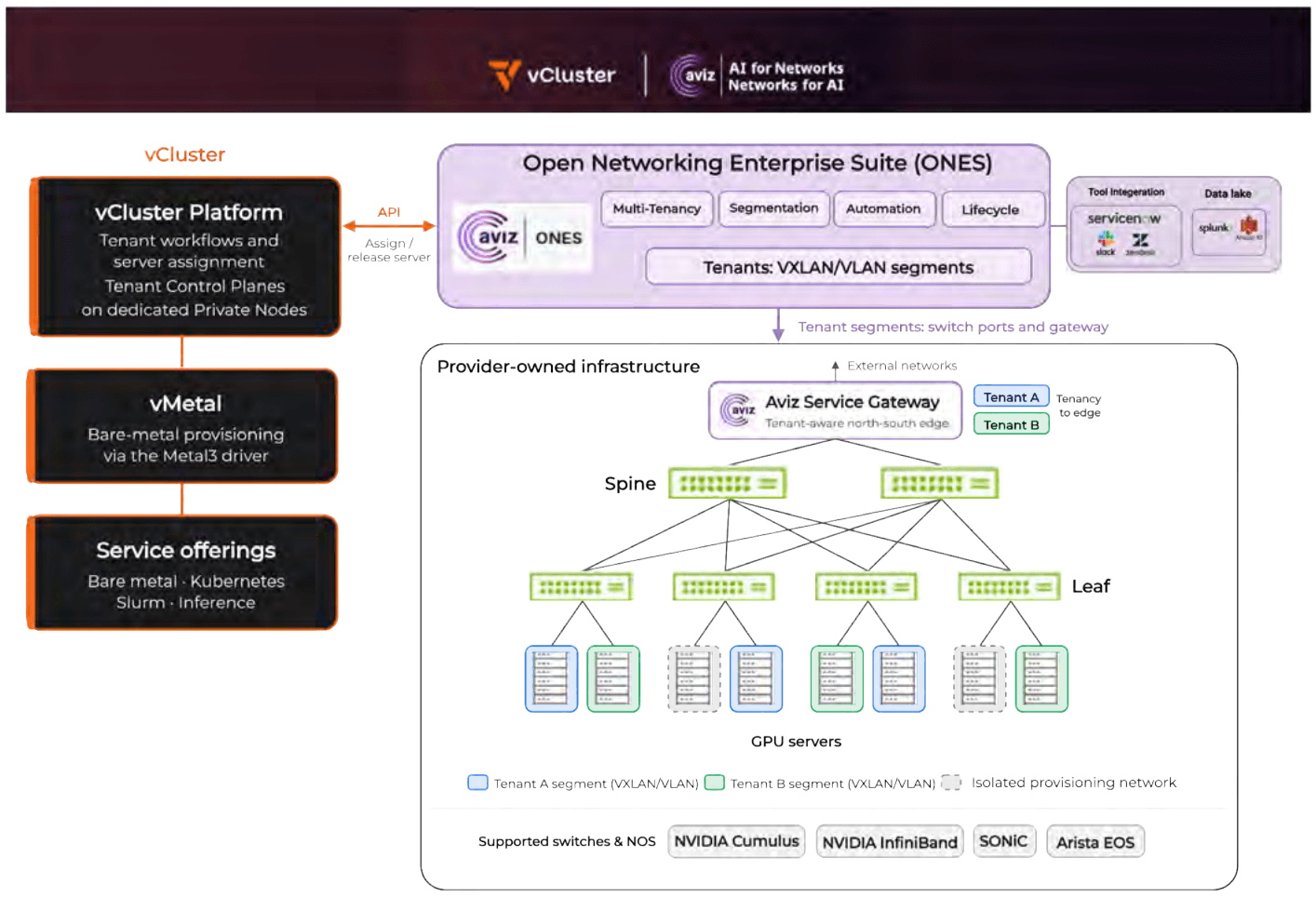
Figure 1: Aviz ONES + vCluster Joint Architecture: Tenant Isolation from Server to Switch to Gateway
When vCluster assigns or releases a server, it calls Aviz ONES, which reconfigures the tenant's switch ports on whichever switches the provider runs.
Who it's for
AI Cloud providers offering bare metal machines or managed tenant clusters to external customers that require network isolation, and AI factories giving each team its own environment and isolated network segment.
Aviz ONES: Tenant Network Orchestration for AI Cloud Providers
Aviz ONES extends each tenant's boundary from the server into the switch fabric. It gives every tenant its own network segment on one shared physical underlay, and changes that segment through an API when vCluster assigns or releases a server.
| Capability | What Aviz ONES delivers |
|---|---|
| Per-tenant segmentation | Each tenant gets its own VXLAN/EVPN or VLAN segment on the provider's switch underlay. |
| Isolated holding network | Unassigned servers sit on an isolated network, separate from every tenant, until vCluster assigns them. |
| VPC peering for shared services | Tenants reach shared services such as storage, DNS, or registries without opening their segment to other tenants. |
| API-driven attach and detach | vCluster calls ONES to move a server's ports onto or off a tenant segment. No ticket, no CLI. |
| Multi-vendor, multi-OS | One tenant model across SONiC, NVIDIA Cumulus Linux and InfiniBand, Arista EOS. |
| Day 0 to Day N lifecycle | Intent-based fabric design, zero-touch provisioning, upgrades, and expansion without disruption. |
| Fabric telemetry | Built-in visibility into switch, port, and tenant segment health, with optional export to Splunk, ELK, or ServiceNow. |
vCluster: Tenant Clusters and Bare Metal on Private Nodes
Once each tenant has its own network, vCluster turns the provider's servers into tenant-ready compute. vCluster provides the control plane, provisioning, and workflow layers.
With vCluster, the provider offers each tenant a dedicated control plane and dedicated nodes. With Aviz ONES underneath, those nodes also sit on a dedicated network.
vCluster runs in production across 100K+ GPUs at 50+ AI Clouds and Fortune 500s. QumulusAI spins up isolated Kubernetes environments in 1 minute, 35x faster customer onboarding at Deutsche Telekom.
End-to-End Workflow: How a Server Moves Between Tenants
In vCluster v5.0, vCluster orchestrates every step, and Aviz ONES makes the network change each time a server is assigned or released. No step waits on a network ticket.
Joint Value and Key Benefits
The joint solution rests on three pillars: isolate every tenant from server to switch, automate the tenant network lifecycle, and offer every cluster type on the switches the provider already runs.
| Capability | Delivered by | Value to customers |
|---|---|---|
| Server-to-switch tenant isolation | Aviz ONES + vCluster | Each tenant gets its own control plane, dedicated nodes, and network segment, meeting the isolation external customers and security teams expect. |
| Automated tenant network lifecycle | Aviz ONES + vCluster | Servers move onto and off tenant networks as they are assigned and released, with no network ticket. |
| Safe server handoff | vCluster + Aviz ONES | Released servers are detached from the tenant's Aviz network and cleaned by vMetal before they are assigned to the next tenant. |
| Tenant addressing | vCluster | Tenant IP addresses are assigned from the subnet the provider sets for each tenant network. |
| Dedicated tenant control planes | vCluster | Each tenant cluster's control plane runs on the provider's control plane cluster. |
| Bare metal provisioning | vCluster vMetal | Servers are provisioned through Metal3 behind one stable API. |
| Multi-vendor fabric choice | Aviz ONES | One tenant model across SONiC, NVIDIA Cumulus Linux and InfiniBand, Arista EOS and Cisco NX-OS. |
| Every cluster type | vCluster + Aviz ONES | Bare metal, Kubernetes, Slurm, and inference share one tenant network model |
| Fabric visibility | Aviz ONES | Built-in telemetry on switch, port, and tenant segment health. |
Use Cases
| Use case | Business challenge | Resulting value to customers |
|---|---|---|
| Bare Metal as a Service for AI Cloud Providers | External tenants rent dedicated GPU servers, and every handoff needs a manual switch change and an isolation check | vCluster assigns the server, and Aviz ONES places it on the tenant's segment in the same workflow. The machine is ready without a network ticket. |
| Managed Kubernetes for external tenants | Tenants expect their own cluster, control plane, and network, not a namespace on shared infrastructure. | vCluster runs a dedicated control plane per tenant on Private Nodes, and Aviz ONES puts the tenant's nodes on its isolated network. |
| Enterprise AI factories | Teams and business units each need their own environment, but the platform team runs one shared fabric. | Each team gets its own tenant cluster and network segment, with VPC peering for shared services such as storage. |
| Mixed services and fabrics | Providers add Slurm, inference, new GPU generations, and new switch vendors over time. | One tenant network model across cluster types and switch vendors. Adding a service or vendor does not mean redesigning isolation. |